





Track Renewal Project on the Saltsjöbanan
News
16 March 2026
Read the article
Date
16 March 2026
Expertises
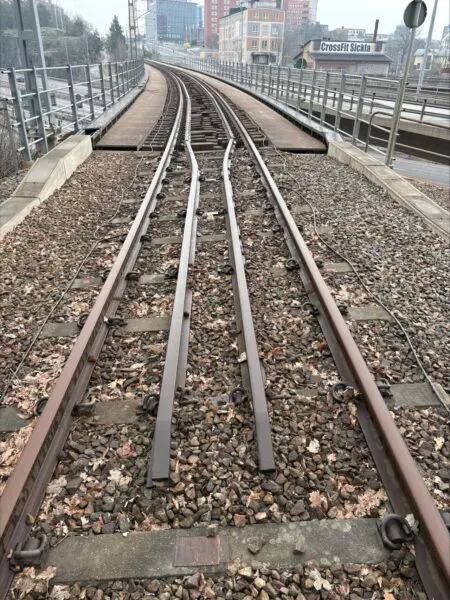
The Public Transport Administration in Stockholm (Trafikförvaltningen) has commissioned Strukton to carry out major track renewal works on the railway bridge crossing Värmdöleden in Nacka Municipality. The 140‑metre bridge is part of the Saltsjöbanan, and the project includes the replacement of rail, ballast and sleepers. The assignment also involves installing new guard rails and replacing the bridge’s expansion device, which ensures the structure can adjust to temperature‑related material expansion and contraction.
Safety will be a top priority throughout the project.
“Because Värmdöleden runs directly beneath the railway bridge, ensuring a safe work environment and preventing any material from falling onto the traffic below is absolutely crucial,” Pia Peurala, District Manager at Strukton Rail Sweden
Work is scheduled to begin on 1 May and is expected to be completed by mid‑October. As standard procedure, a contractual standstill period is currently in effect before the agreement can be formally signed.
Ageing bridges can be reinforced using composite strengthening systems such as SUREbridge, which places a lightweight FRP composite panel onto the existing concrete deck. This method increases load‑bearing capacity, extends service life by up to 50 years, shortens construction time and avoids demolition, lowering CO₂ emissions by around 50%.
Current sustainable bridge‑building practices include the use of high‑strength concrete, recycled and circular structural beams, and composite panels that minimise the need for new raw materials. Circular approaches — such as reusing beams and strengthening existing structures instead of replacing them — significantly reduce waste, transport movements and environmental footprint. SUREbridge, for example, limits the use of primary materials and enables lightweight installation with minimal environmental impact.
Techniques like prefabricated composite deck overlays, fast‑curing strengthening systems and modular construction minimise on‑site work and reduce noise, traffic disruption and construction time. SUREbridge, for instance, avoids demolition and can be installed in just a few weeks, reducing inconvenience to road users and nearby residents.
Movable bridges rely on advanced bridge‑control and monitoring systems that manage mechanical movements, ensure safety interlocks, support remote operation and monitor real‑time performance. Modern systems integrate sensors, automation and fail‑safe logic to guarantee safe bridge openings while coordinating with traffic, vessels and other infrastructure elements. Many engineering firms specialising in rail and civil infrastructure provide expertise in designing, upgrading and maintaining such systems.
Railway bridges must withstand heavy axle loads, dynamic vibrations and increasing train frequencies. Important considerations include structural stiffness, fatigue resistance, long‑term durability and compatibility with electrification systems. With many European railway bridges exceeding 50–100 years of age, strengthening methods such as composite overlays, high‑strength materials and smart monitoring systems are increasingly used to extend lifespan and ensure safe operations.
Railway construction in European urban areas faces several challenges, including limited space, strict environmental regulations and the need to manage noise and vibration in line with European rail standards. Complex public transport networks, high population density and the demand for uninterrupted urban mobility add further constraints.
The cost of constructing a new railway line in Europe depends on several key factors, including route length, local geography, environmental requirements and the complexity of the surrounding rail infrastructure. Prices can range from several million to hundreds of millions of euros, depending on whether the project involves urban environments, tunnels, bridges or upgrades to existing public transport networks.
Strukton delivers tailored railway engineering solutions and provides expert advice on cost optimisation through smart design, efficient project planning and sustainable construction techniques. By applying innovative technologies and meeting European rail standards, we help clients reduce lifecycle costs while ensuring reliable, future‑proof transport connections.