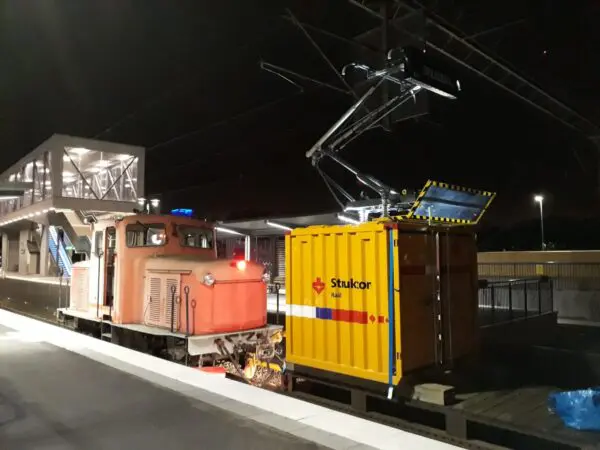






Rail Maintenance Contract in Eslöv
News
07 March 2025

Read the article
Date
17 October 2019
Expertise
POSS, Strukton’s monitoring system, uses big data, IoT and machine learning technology to provide rail asset owners with 24/7 insight into the performance of critical assets. Smart algorithms analyse and interpret the collected data and report on the root causes of failure modes. This enables asset owners, managers and contractors to intervene at the right time and at the right place.
One of the many heard challenges faced by railway asset managers is the obligation to achieve strict network performance objectives while the infrastructure is subjected to higher loads due to a higher frequency of train services. The ascending number of passenger kilometres implies increased degeneration of network performance, while less time is available for inspection and maintenance activities. This calls for a targeted maintenance approach.
As a smart rail maintenance specialist, Strukton Rail strives for continuous improvement of maintenance processes, resulting in optimised network availability. A key component of its approach is the transfer of condition data into predictive values and actionable information.
The POSS Online platform R7 improves the insight into the condition of assets, enabling asset managers to better manage and control maintenance processes. POSS Online R7 converts asset condition data into information that adds predictive value to maintenance strategies. It simply facilitates to look back, look at and to forecast asset-performance by identifying improvement potential. It does so through advanced analysing tools and by deploying smart algorithms coupled to domain knowledge in order to automate the root cause analysis and provide actionable information. This supports the transition from a time-based maintenance regime to a predictive maintenance regime.
The new POSS Online R7 platform acts as a virtual maintenance assistant supporting the development of maintenance strategies. The Strukton Control Center evaluates actionable information to assist rail asset managers during their transition capturing the potential of an predictive maintenance strategy.
Obviously the POSS Online R7 platform facilitates the use of smartphones, laptops and other devices to obtain and exchange performance information. The platform facilitates multiple users and applications, and connects to other existing and upcoming platforms. The open architecture makes the platform and analysis tooling future-proof for integration with e.g. IoT sensing technology. This provides uniformity and standardisation in the journey to the next step(s) in predictive maintenance to achieve optimised availability and safety against lower TCO.
POSS monitoring: Smart, Predictive and Always Insightful
Sustainable asset management balances performance, cost efficiency and environmental impact across the entire lifecycle of infrastructure. It focuses on extending asset life, minimising failures and reducing CO₂ emissions through smarter maintenance planning and responsible material use. Modern approaches increasingly integrate predictive maintenance and sustainability goals to improve long‑term resilience. The POSS monitoring system and Eurailscout’s inspection trains are examples that boost sustainable asset management.
Data is the foundation of smart maintenance. By collecting condition data from inspections, sensors and monitoring systems, infrastructure managers gain accurate insight into the health of their assets. When combined with analytics, software and AI, this data enables predictive maintenance frameworks that reduce downtime, improve reliability and support informed, long‑term decision‑making.
Predictive maintenance helps prevent unexpected failures, avoids costly emergency repairs and keeps infrastructure available at the lowest operational impact. By identifying deviations at an early stage, repairs can be scheduled during planned maintenance windows—often at night—reducing disruptions and improving asset performance. Studies show predictive models significantly reduce unplanned outages and improve safety across transport networks.
Data‑driven asset management provides an understanding of the condition and remaining lifespan of existing structures and assets. This insight enables infrastructure owners to plan renovations and renewals more efficiently, allocate investments wisely and reduce environmental impact by avoiding premature replacement. Advanced asset analytics help organisations make smart decisions and prioritise upgrades where they deliver the most value.
Asset management applies to rail infrastructure, roads, tunnels, waterways and all other civil structures where safety, availability and sustainability are essential. Whether managing complex rail networks or urban mobility systems, modern asset management frameworks—often supported by AI and predictive analytics—strengthen performance and ensure future‑proof infrastructure across Europe.