





Jacques Tiecken
Projectleider
Date
20 June 2023
Expertises
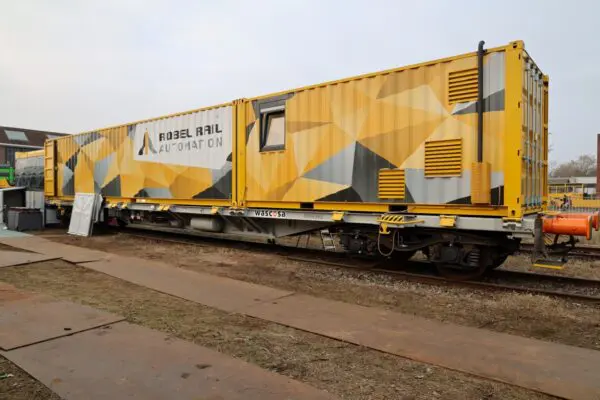
“When we started the Leonardo project a few years ago, we wanted to scan everything within a 5-metre radius of the surveyor train: top, bottom, left and right. We managed to do most of that with cameras and laser measurement systems, but we couldn’t yet look in the ground. This has changed thanks to the purchase of our 3D ground radar with the latest technology,” says Jacques Tiecken, Leonardo Project Manager.
Jacques came in contact with Silvester Ramaker, who was working at another agency at the time. Together, they took the Leonardo for a test drive with a radar antenna underneath, and Jacques was convinced straight away. This was in May 2022 and they ended up purchasing the system. Silvester: “The 3D radar is different to what we had been using on the railway up to then. It can measure slightly deeper and provides a higher resolution (measurement density). That combination gives you much more detail in the image. We not only see the varying ballast thicknesses but also the cables and pipes, coupling rails and tunnel boxes, plus the related baffle plates as well as the deeper soil layers. With a topographic subsurface under the radar data, you can see all the things you suspected were there.”
Jacques: “The radar depth depends on the soil type. On clay and peaty soils, we get down to around 1 to 1.5 metres in the soil, while on sandy soils we achieve depths of 3.5 to 4 metres. After extensive trials, we found that at 80 km/h we got good results with ground-based radar. This is consistent with the plan to get Leonardo to drive between the trains at line speed.”
Ground radar is proving to be very useful for track maintenance. Jacques gives some real life examples. “We discovered ballast pockets, which are points just before a level crossing where the ballast is pushed deeper and deeper due to frequent maintenance. In places like this, the sleepers are no longer supported properly.
Many of the switches around Haarlem railway station are known to have stability problems. That requires the use of lots of tamping machines. With ground radar, we discovered whole sections under the track and under the sleepers with almost no ballast. Quite shocking really! I don’t think anyone expected this because ballast thickness is often measured at the head of the sleepers.”
We made another fascinating discovery under the Maas Line. “There, over a stretch of 500 metres, we found that the ballast layer was up to 2.5 metres deep. It was probably an old riverbed that had been plugged with ballast when the railway was being built.”
Badger setts under railway lines are currently a big news item in the Netherlands. Can they be detected too? Silvester: “We can detect cavities with ground radar, but there’s no label attached. A casing tube is also a type of cavity. That gives roughly the same kind of image as a badger sett. The question then is whether there is a casing tube directly under the ballast. That isn’t logical. If the tunnel isn’t dead straight, you tend to assume it’s the burrow of some animal. Suspicious spots are indicated with GPS coordinates and on location you can then easily check whether you see an entrance to a badger sett on the outside. For casing tubes, of course, we also have ProRail’s base maps that we can link to the measurement data.”
How does it work with explosives? “I sometimes see objects and have an idea about them but you always have to be careful. I can’t say with certainty that something is an old bomb, and I’m not qualified to do that. But I can advise the maintenance department and say there’s an iron object located there.”
“Because the badger is a protected species, we worked very carefully”, explains Project Manager Aart van de Meent.
Ground radar is also a welcome addition to a baseline measurement on a project. Jacques: “We recently drove with the radar over the Leeuwarden yard, which we are planning to renovate. Are there any objects in the ground that we need to know about when we start implementing a project? After finishing a project, we drive over the yard again and you can see the improvements. Radar measurement also comes in handy in the tender procedure for a PBM (contract area). The exact condition of the subsurface is then known in advance.”
Because this is a new technology, Jacques is still a little hesitant. “We have to show that what we think is accurate and that our data is correct. Validation of the system is a requirement for ProRail but it is also important for us. If we’re going to adjust our maintenance to what we’re seeing with ground radar, it has to be right.”
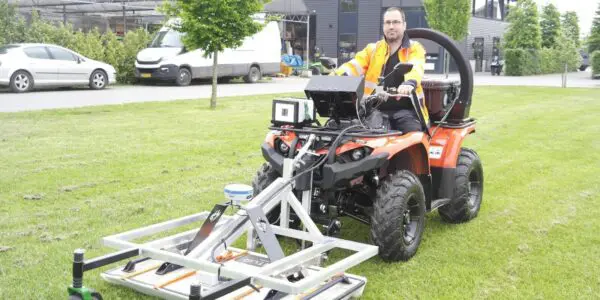
A converted electrically-powered quad bike was recently purchased to take measurements along the track as well. The quad will be operational by mid-May. The radar control unit is interchangeable with the Leonardo. However, the quad has a narrower antenna – 1.20 metres versus 2.10 metres. This makes it easier to drive along the inspection path and elsewhere.
Jacques: “We plan to map out cables and pipes along the Betuwe Route. These are located on the outside of the noise barriers and the soil there has subsided. In some places piles have been driven and the cables are not subsiding, which means they are under tensile stress and can start to break. It’s a great first assignment from ProRail to deploy the quad.”
Projectleider
Sustainable asset management balances performance, cost efficiency and environmental impact across the entire lifecycle of infrastructure. It focuses on extending asset life, minimising failures and reducing CO₂ emissions through smarter maintenance planning and responsible material use. Modern approaches increasingly integrate predictive maintenance and sustainability goals to improve long‑term resilience. The POSS monitoring system and Eurailscout’s inspection trains are examples that boost sustainable asset management.
Data is the foundation of smart maintenance. By collecting condition data from inspections, sensors and monitoring systems, infrastructure managers gain accurate insight into the health of their assets. When combined with analytics, software and AI, this data enables predictive maintenance frameworks that reduce downtime, improve reliability and support informed, long‑term decision‑making.
Predictive maintenance helps prevent unexpected failures, avoids costly emergency repairs and keeps infrastructure available at the lowest operational impact. By identifying deviations at an early stage, repairs can be scheduled during planned maintenance windows—often at night—reducing disruptions and improving asset performance. Studies show predictive models significantly reduce unplanned outages and improve safety across transport networks.
Data‑driven asset management provides an understanding of the condition and remaining lifespan of existing structures and assets. This insight enables infrastructure owners to plan renovations and renewals more efficiently, allocate investments wisely and reduce environmental impact by avoiding premature replacement. Advanced asset analytics help organisations make smart decisions and prioritise upgrades where they deliver the most value.
Asset management applies to rail infrastructure, roads, tunnels, waterways and all other civil structures where safety, availability and sustainability are essential. Whether managing complex rail networks or urban mobility systems, modern asset management frameworks—often supported by AI and predictive analytics—strengthen performance and ensure future‑proof infrastructure across Europe.
Railway maintenance refers to all activities required to keep rail infrastructure safe, reliable and in optimal condition. This includes tracks, switches, overhead lines, sleepers, ballast, power supply, cables, ducts and signalling systems. Routine inspections and major renewal activities such as rail grinding, tamping and ballast maintenance are essential to ensuring long‑term track performance. Asset management plays a crucial role in rail maintenance.
The purpose of railway maintenance is to ensure the safety of passengers and train operations, prevent failures and delays, extend the lifespan of rail assets and avoid costly repairs by resolving issues early. Maintenance is vital for keeping high‑usage rail networks reliable and efficient, reducing disruptions and supporting sustainable rail operations.