




Robert Galjaard
Innovator
Date
20 September 2023
Expertises
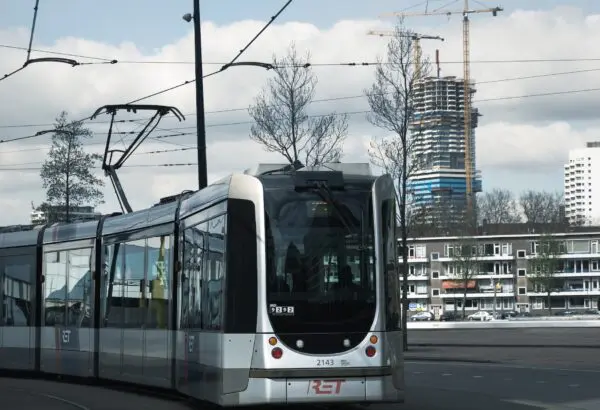
Rotterdam’s public transport operator RET and consortium Energieverbinders (Dutch for Energy Connectors) have joined forces for a pilot that will lead to the realisation of the first Energy bank for the tram. The energy bank must be operational in December. The Energy bank will strengthen the power supply at the Posthumalaan turn loop, enabling RET to use the loop as a transfer point for passenger flows to Rotterdam Central Station and for soccer events.
When the Energy bank proves to be operating according to plan, the way will be open to solutions for more bottlenecks due to energy network congestion. The innovative power of Europe’s Rail Joint Undertaking, part of the EU’s Horizon Europe Programme (2020-2027) is used for the pilot.
RET built a tram turn loop at the Posthumalaan in Rotterdam a couple of years ago. This loop is currently used for calamities only. Once the power supply has been strengthened, the turn loop will also be suitable for tram traffic between the Kuip stadion and Wilhelminaplein metro station. Normally, an additional substation is necessary to strengthen the power supply, but that is costly, time consuming and wastes a lot of space.
The Energy bank is a good alternative for a substation. The concept was developed by consortium Energieverbinders (Dutch for Energy Connectors), consisting of Strukton Rail, Strukton Power and Hedgehog Applications. With modern technology and energy storage facilities, they developed a compact ‘unplugged substation’.
The Energy bank is identical to a classical rectifier station in terms of characteristics, but it is not connected to the electricity grid. The Energy bank charges itself through the catenary system of the tram at moments when no tram is passing (both during the day and at night) and makes sure that the energy is charged when electricity rates are low or even negative. This high-tech system serves as a fully operational extension of a classical power supply system with rectifier stations.
The concept of the Energy bank only consisted on paper, until now. The Energy bank in Rotterdam is therefore a world first. Realising the Energy bank in practice will lead to two positive results:
Characteristics of the Energy bank include:
Photo: Victor through Unsplash
This innovation contributes to Social Development Goal (SDG) 7 -Affordable and clean energy. Our current reliance on fossil fuels is unsustainable and harmful to the planet, which is why we have to change the way we produce and consume energy. Implementing these new energy solutions as fast as possible is essential to counter climate change, one of the biggest threats to our own survival. We actively wish to contribute to the United Nation’s SDGs, focusing on SDG 7, 8, 9, 12, 13, 15 en 17.
Energieverbinders (Energy connectors) is a consortium of Strukton Rail Nederland, Strukton Power and Hedgehog Applications. They have joined forces to solve problems of energy network congestion with modern technology and energystorage facilities and, in so doing, accelerate the energy transition.
Innovator
Sustainability in rail and civil engineering focuses on reducing environmental impact across the entire lifecycle of infrastructure. This includes using emission‑free equipment, circular and recycled materials, and designing assets with a longer lifespan and lower maintenance requirements. Reusing structural components—such as circular viaduct beams or recycled copper contact wires for overhead lines—significantly reduces CO₂ emissions while conserving valuable raw materials.
CO₂‑reduction is achieved through a combination of clean construction methods and material innovation. Key strategies include:
These measures not only reduce carbon emissions but help create more resilient, future‑proof infrastructure.
Infrastructure projects increasingly rely on advanced sustainable technologies, such as:
These innovations drive measurable environmental benefits throughout the asset lifecycle.
Zero‑emission equipment refers to machinery that operates without producing exhaust gases, typically powered by electricity or batteries. Examples include:
This equipment eliminates local emissions, improves air quality around work sites, reduces noise pollution and helps clients comply with increasingly strict sustainability requirements.
By 2050, the infrastructure sector aims to be fully climate‑neutral. This future includes:
The transition is already underway, driven by innovation, collaboration and long‑term thinking.
Expanding the electricity grid is crucial to support increasing demand from renewable energy, electric mobility, gas‑free homes and growing data‑center capacity. A larger and stronger grid ensures reliability, prevents congestion and enables the seamless integration of solar, wind and other sustainable energy sources.
Modern energy networks rely on extensive civil engineering works, including the construction of high‑voltage substations, transmission‑line foundations, access roads, cable routes and site preparation for electrical stations. These works form the physical backbone that allows grid operators to expand capacity safely and efficiently.