





Rail Maintenance Contract in Eslöv
News
07 March 2025

Read the article
Date
18 November 2020
Expertise
As an example in our own performance based contracts in the Netherlands.
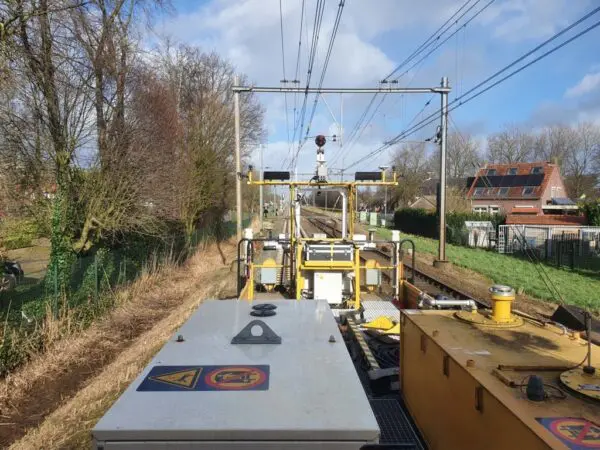
We knew at forehand that three separate railcars would be needed to carry out the measurements due to the presence of narrow-gauge tracks (891 mm instead of the conventional 1435 mm) at one of the networks. Another line was a city line and use of the same railcar on this line is prohibited.
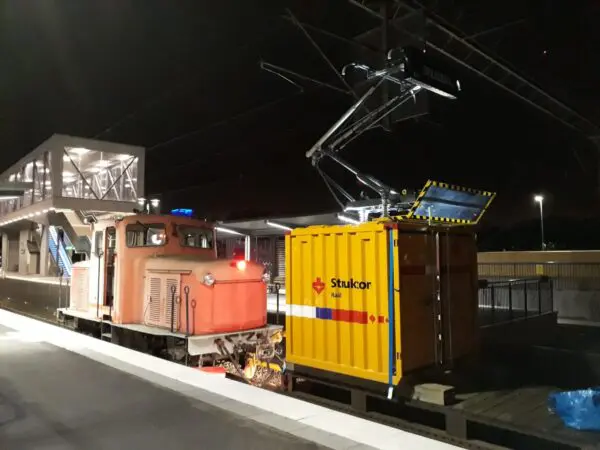
In addition to carrying out the measurements, a lot of conversion work was required to fit up the different railcars. This went very smoothly in cooperation with our Swedish colleague, so that the measurements were carried out on time.
Over a period of two weeks, a total of approximately 150 kilometres of overhead lines, divided across three different lines/city networks, were measured. Reports for the 3 measured networks (Roslagsbanan, Lidingöbanan and Spårväg City) were generated on the basis of the measurements. Different parameters were measured: thickness, shift, level and hard points. No alarming thin points were found, although several overhead line sections were found to be in need of repair over the short term. Strukton Sweden will perform these repairs independently, since we are responsible for maintaining these lines.
The measurement results are currently being worked out and analysed in further detail. The results will be presented to the customer, Storstockholms Lokaltrafik (SL). The results will serve as input for the development of renovation plans and trend analyses.
Due to the Strukton Wire Scan’s flexibility, it can be used anywhere there are overhead lines. This includes lines where Strukton is not responsible for the maintenance. This means there is significant market potential. Aside from the flexibility of use, the measuring systems produces high-quality results.
The goal is to deploy the Strukton Wire Scan in as many countries as possible. Almost any railcar can be equipped with this measuring system, if needed with some minor adjustments. The Strukton Wire Scan will be used again over the coming period for PDM contracts.
The original measurements were planned for September. At that point an orange travel advisory was in effect and the work was deferred to the middle of October. At the end of August, the travel advisory was downgraded to yellow as a result of which there was sufficient time to make the necessary preparations. The travel advisory has since reverted back to orange.
The Strukton Wire Scan measures the overheid wires
Sustainable asset management balances performance, cost efficiency and environmental impact across the entire lifecycle of infrastructure. It focuses on extending asset life, minimising failures and reducing CO₂ emissions through smarter maintenance planning and responsible material use. Modern approaches increasingly integrate predictive maintenance and sustainability goals to improve long‑term resilience. The POSS monitoring system and Eurailscout’s inspection trains are examples that boost sustainable asset management.
Data is the foundation of smart maintenance. By collecting condition data from inspections, sensors and monitoring systems, infrastructure managers gain accurate insight into the health of their assets. When combined with analytics, software and AI, this data enables predictive maintenance frameworks that reduce downtime, improve reliability and support informed, long‑term decision‑making.
Predictive maintenance helps prevent unexpected failures, avoids costly emergency repairs and keeps infrastructure available at the lowest operational impact. By identifying deviations at an early stage, repairs can be scheduled during planned maintenance windows—often at night—reducing disruptions and improving asset performance. Studies show predictive models significantly reduce unplanned outages and improve safety across transport networks.
Data‑driven asset management provides an understanding of the condition and remaining lifespan of existing structures and assets. This insight enables infrastructure owners to plan renovations and renewals more efficiently, allocate investments wisely and reduce environmental impact by avoiding premature replacement. Advanced asset analytics help organisations make smart decisions and prioritise upgrades where they deliver the most value.
Asset management applies to rail infrastructure, roads, tunnels, waterways and all other civil structures where safety, availability and sustainability are essential. Whether managing complex rail networks or urban mobility systems, modern asset management frameworks—often supported by AI and predictive analytics—strengthen performance and ensure future‑proof infrastructure across Europe.