


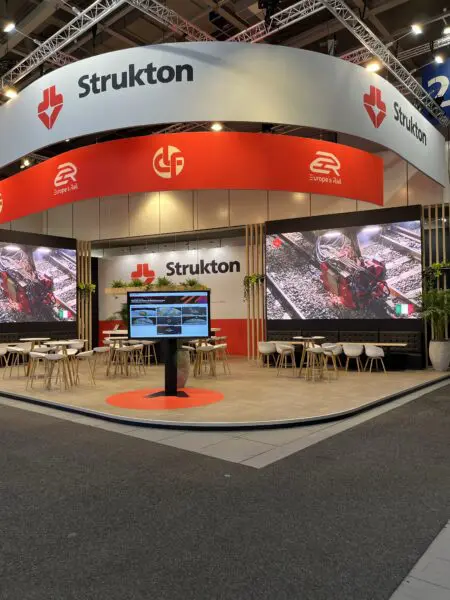
Looking Back on a Successful InnoTrans 2026
News
25 September 2026
Read the article
Expertises
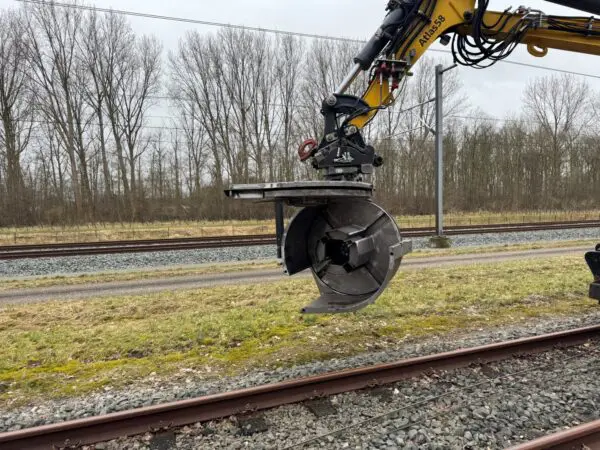
To make the work of our overhead line technicians safer and less physically demanding, Strukton is taking an important step in the robotisation of activities related to the removal of old overhead line equipment. In collaboration with Nijhuis, Strukton has developed a new tool: an innovative reel-winding robot. This unit can be attached to a rail maintenance vehicle and fully mechanises the labour-intensive process of cutting, collecting and bundling old wires.
The removal of old contact wires is currently carried out entirely by hand. Wires are cut into sections of no more than three metres and then collected from the track. For a 500-metre wire, this means more than 330 heavy cutting actions. Support cables are also cut into sections, wound up and manually loaded into containers, with each reel weighing approximately 15 kilograms.
This represents a significant physical burden for our technicians. The new reel-winding robot helps ensure the sustainable employability of our workforce. Its enclosed drum prevents loose parts from flying away during winding, and the unit can unload the wound bundles directly into a container on the wagon positioned behind the crane.
To further develop the idea, we partnered with Nijhuis, a company with extensive experience in specialised railway machinery. Working together with operators from Strukton’s crane fleet, we built a prototype that fully meets practical safety and operational requirements.
The first trial took place during a project in Lelystad. The results exceeded expectations: the unit performed exactly as intended from the outset. Technicians were impressed by its ease of use and, above all, relieved that the physical strain associated with these activities could be reduced so significantly.
The development of the reel-winding robot is an excellent example of how innovation emerges from practical experience, collaboration and craftsmanship. With this innovation, we are taking an important step towards safer, more efficient and future-proof overhead line operations.



Rail construction plays a crucial role in Europe’s shift towards low‑carbon mobility. By expanding and modernising electric rail infrastructure, the sector enables cleaner transport that produces significantly lower CO₂ emissions than road or air travel. At the same time, energy‑efficient work methods—such as using low‑emission machinery, hybrid traction systems and digital tools that extend asset life—help reduce the environmental footprint of construction activities. Together, these developments strengthen a sustainable mobility network and accelerate progress towards European climate goals.
In rail construction, highly specialised machinery ensures that work is carried out safely, efficiently and with minimal disruption. Typical equipment includes track‑laying trains, tamping machines, rail welding units, road‑rail excavators and ballast profiling systems, each designed to build or restore track structures with precision. These machines support both large‑scale track installation and daily maintenance operations. Innovations in automation and robotics are increasingly enhancing productivity and safety, helping infrastructure managers deliver consistent quality in a growing European rail network.
Safety is maintained through strict operational procedures in combination with modelling and prioritisation based on asset criticality. Intelligent asset management and real‑time monitoring technologies help identify risks at an early stage and ensure trains can continue to operate safely. These systems support long‑term investment planning and maintain the reliability of the rail network.
Because European rail networks are heavily used, maintenance is often carried out during night‑time or weekend possessions when fewer trains are running. High‑traffic lines require carefully planned maintenance windows to minimise service disruptions while ensuring infrastructure remains safe and in good condition.
Maintenance priority is determined using asset condition models and long‑term asset management strategies. This enables companies and railway managers to forecast the future state of critical rail components, helping planners intervene at the optimal moment. Intelligent asset‑management systems make it possible to compare scenarios, estimate remaining service life and plan renewals efficiently based on operational needs and strategic investment priorities.
Modern railway maintenance combines condition monitoring, inspection data, advanced algorithms and expert domain knowledge to support data‑driven decision‑making. Digital tools and predictive analytics help maintenance teams detect issues earlier, schedule interventions more effectively and continuously improve the maintenance cycle. These approaches are increasingly adopted across Europe to boost reliability and reduce unplanned downtime
The purpose of railway maintenance is to ensure the safety of passengers and train operations, prevent failures and delays, extend the lifespan of rail assets and avoid costly repairs by resolving issues early. Maintenance is vital for keeping high‑usage rail networks reliable and efficient, reducing disruptions and supporting sustainable rail operations.